Prompted by the opening of the new all-inclusive RIU on Boa Vista, Radiotelevisão Caboverdiana reports on the unseen problems caused by tourism development.
This includes the sudden unemployment of as many as 500 migrant workers who now swell the growing barracas (slums) in Sal Rei.
You can see the full report here:
RTC report on problems caused by tourism development
Monday, May 9, 2011


Thursday, May 5, 2011
Build your own rubbish bin on Earth Day
One of the biggest hazards to marine turtles is rubbish, so what better way to teach children about the environment and turtles than to make them think about what they do with their rubbish.
Escola Nova in Espargos, the capital of Sal had a problem with disposing of rubbish in the classrooms because of the lack of bins, so SOS organised a competition to get the kids to design and make their own bins using recycled materials.
 A ceremony was held on Friday with judges from SOS Tartarugas, the Delegation for Education and the Peace Corps with the winners receiving a map of the world and some art & craft materials.
Only three grades were involved but this still meant 600 children! Each bin had an environmental message written on it and a representative from each class came forward and described the materials used for their bins and explained the message. The bins all showed a great level of creativity and imagination and choosing three winners was very difficult.


In the end the judges chose three bins based on the creative use of materials, while of course our favourites were those that incorporated turtles in the design!
Escola Nova in Espargos, the capital of Sal had a problem with disposing of rubbish in the classrooms because of the lack of bins, so SOS organised a competition to get the kids to design and make their own bins using recycled materials.
 A ceremony was held on Friday with judges from SOS Tartarugas, the Delegation for Education and the Peace Corps with the winners receiving a map of the world and some art & craft materials.
Only three grades were involved but this still meant 600 children! Each bin had an environmental message written on it and a representative from each class came forward and described the materials used for their bins and explained the message. The bins all showed a great level of creativity and imagination and choosing three winners was very difficult.


In the end the judges chose three bins based on the creative use of materials, while of course our favourites were those that incorporated turtles in the design!
Thursday, April 28, 2011
The turtle season is almost here!
On our second day back on Sal, the real work begins. The main things are in place, funding and the all important team of paid Rangers and volunteers and now we are finalising the plan with the Camara Municipal do Sal.
This year we face a couple of new challenges, including the massive increase in activity on the main nesting beach of Algodoeiro/Ponta Preta. Lighting will deter many of our usual visitors from laying their nest and will also mean that any nests that are laid will need to be relocated to a safe place. It's a shame that the developers are not responsive to any suggestions of how to improve the situation and keep turtles coming back to this area.
Our other challenge is to keep turtles safe on Mont Leao which has a history of almost 100% mortality of any that come ashore. We hope to have a semi-permanent camp there that will not only act as protection but also an education and information point.
On the plus side, we will once again be running a workshop in July for people from other islands who are working with, or wish to work with turtles. One of the objectives of the project is to try to stimulate conservation activities amongst communities and to fund activities where there are no resources available.
Another highlight could be returning turtles from 2008. This was the first year of the project and it would be incredibly exciting to see some of the first ones we ever tagged back on the beach again.
We still have a few places open and are especially interested in hearing from German speakers.
This year we face a couple of new challenges, including the massive increase in activity on the main nesting beach of Algodoeiro/Ponta Preta. Lighting will deter many of our usual visitors from laying their nest and will also mean that any nests that are laid will need to be relocated to a safe place. It's a shame that the developers are not responsive to any suggestions of how to improve the situation and keep turtles coming back to this area.
Our other challenge is to keep turtles safe on Mont Leao which has a history of almost 100% mortality of any that come ashore. We hope to have a semi-permanent camp there that will not only act as protection but also an education and information point.
On the plus side, we will once again be running a workshop in July for people from other islands who are working with, or wish to work with turtles. One of the objectives of the project is to try to stimulate conservation activities amongst communities and to fund activities where there are no resources available.
Another highlight could be returning turtles from 2008. This was the first year of the project and it would be incredibly exciting to see some of the first ones we ever tagged back on the beach again.
We still have a few places open and are especially interested in hearing from German speakers.
Friday, April 22, 2011
Friday, March 11, 2011
Tiny turtles tagged
 By customising tiny 9gm tags usually used for birds, scientists have been able to track a group of 4-6 month old turtles. The turtles were released in Palm Beach. Prof Wyneken of Florida Atlantic University said "The turtles varied a lot in their movements, more so than we expected. They're likely doing much more than just paddling straight to the deep water and riding the current."
Now if we could only raise £32,000 we could tag one of our own little loggerheads!
Read the full story here.
Wednesday, March 9, 2011
Tag a Turtle Project, Newquay, England
The Tag a Turtle project aims to raise enough funds to satellite tag the next turtle that finds itself lost and in need of rehabilitation at the Blue Reef Aquariam in Newquay. Many of the recently stranded turtles have been loggerheads.
The project needs to raise £3,000. Congratulations to Nicola and Nicole on this great initiative.
You can read more about in on their website Tag a Turtle
The project needs to raise £3,000. Congratulations to Nicola and Nicole on this great initiative.
You can read more about in on their website Tag a Turtle
Monday, March 7, 2011
Cape Verde Shearwater in danger
Sadly it's not only the turtles that face extinction in Cape Verde.
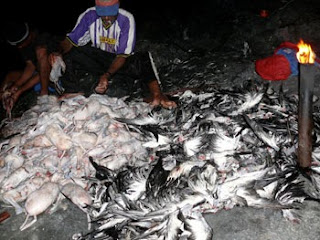

The Cape Verde shearwater (calonectris edwardsii, known here as the cagarra) also faces a severe threat from hunting. The birds are killed for food just before they are ready to leave the nest.
Even after awareness campaigns and other activities hunting of the fledglings continue, as José Melo says "it is causing the extinction of a species that only exists in Cape Verde, 70% of them on Raso islet and also near Rombo islet, next to Brava. It doesn’t exist anywhere else in the world.”
Read the full article here
Subscribe to:
Posts (Atom)


 Posts
Posts