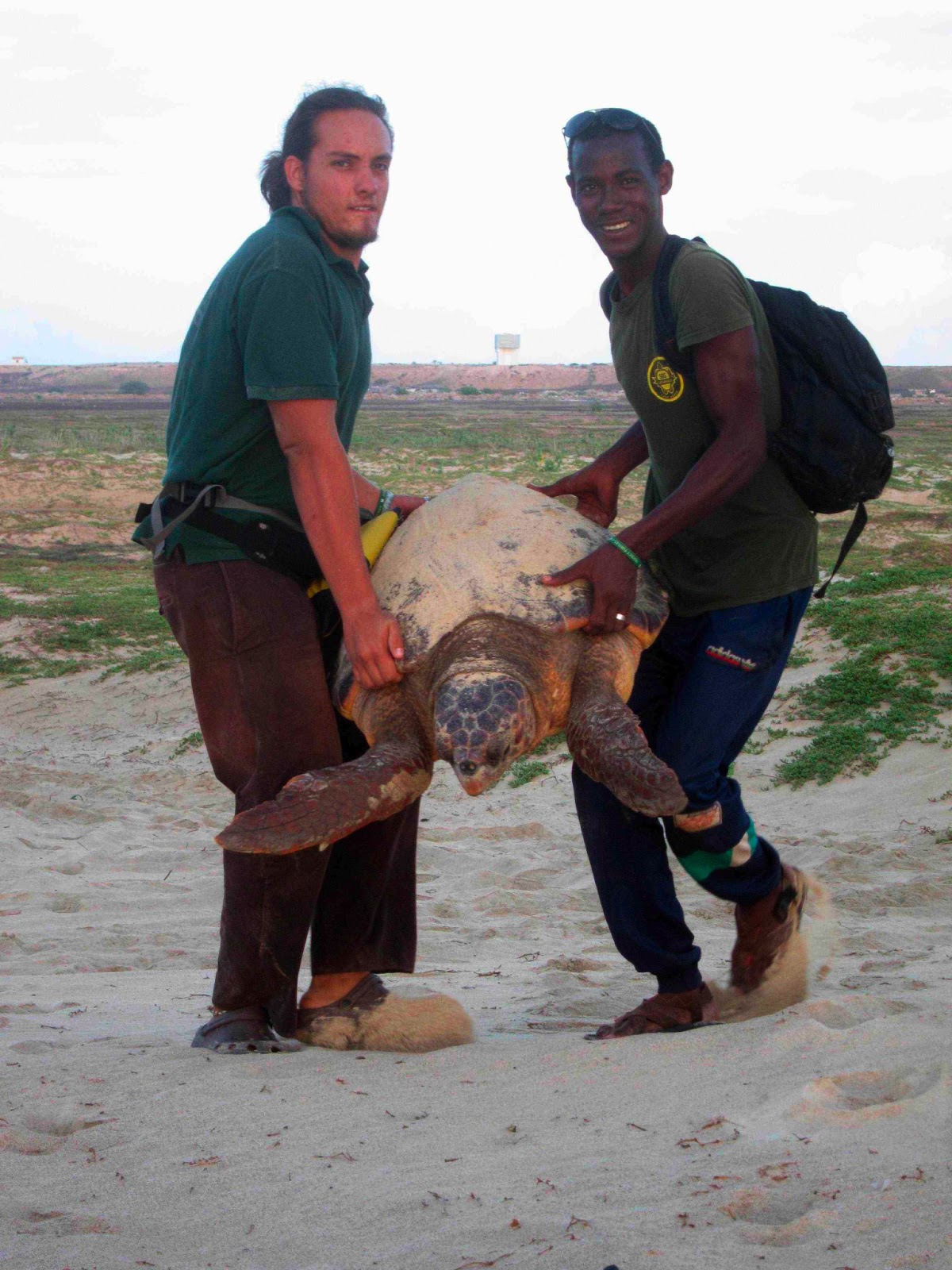
SOS Tartarugas works in Cape Verde protecting nesting loggerheads turtles (Caretta caretta) and their habitat. Cape Verde is the third most important nesting area for loggerheads in the world. Turtles are at risk from hunting for meat, stealing of eggs, removal of sand for building and unregulated tourism development. Our email is info@turtlesos.org.
P
lease subscribe to the blog or follow us on Twitter or on our Facebook page to keep up to date. (You can also read this blog in a different language, please use the tool in the sidebar).
You can apply to volunteer with us by clicking here.

Wednesday, February 6, 2013

Key positions still available saving turtles in Cape Verde

It's been another fantastic year for applications but we still have a few key positions open.  Each year the standard gets higher and there are obviously a lot of very motivated people out there who want to make a contribution to biodiversity conservation.

Even though the deadline has passed, if you have the qualities & experience for these paid places, please send us your application.  We will keep accepting applications until we find the right person.  Click on the links for full descriptions.
Tourism Rangers work hands on at the hatchery

Tourism Ranger
Giving information to visitors to the hatchery and guiding guests on turtle walks is a key part of this job, but it is still hands-on with turtles.  Tourism Rangers go through the same training as Wildlife Rangers and perform many of the same duties such as collecting data and relocating nests.  You need to be outgoing and have good communication skills.  Preferred languages are English, German, French, Dutch & Italian. 

Tourism Manager
Similar to above but should have some experience of working with tourists or in a customer facing role.  Must also have very good organisational skills.
Serra Negra

Camp Coordinator
Take charge of the most important beach on Sal for nesting turtles.  Beautiful, isolated Serra Negra is where our camp is situated.  You should have previous experience working with turtles and should be able to speak either Capeverdean Kriolu, Portuguese or Spanish.

Download the application form here.  (This takes you to Google Docs - click on File and Download in the drop down menu)

Tuesday, February 5, 2013

All about turtles in Cabo Verde

An excellent initiative by the Scientific Committee of TAOLA (The Capeverdean Sea Turtle Network) has brought together all the literature that has ever been published on turtles in the archipelago.  It includes research articles, chapters in books & doctoral theses and the aim is to provide a useful resource for sea turtle workers in the country and abroad.

The list can be downloaded here.

Wednesday, January 30, 2013

Anti-breakwater petition dismissed as irrelevant by The Resort Group.

To say that our views and the views of The Resort Group (TRG) are different is somewhat of an understatement!  But trying to find some middle ground where we can work together to protect the environment and ensure the economic development of the country is very important.  With this in mind, we had a very lively and interesting discussion with TRG's representative, Victor Fidalgo about turtle conservation in general and the controversial breakwater proposal in particular.

There is no question that the tourism development of Algodoeiro on the west coast of Sal has had a serious impact on loggerhead turtles but in the last couple of years TRG has implemented some mitigation measures such as installing red filters in the beach bar and, in 2012, made a small donation to our general fund.  However, naturally, as a for-profit enterprise, TRG's objectives are primarily financial gain.

Additionally, Mr Fidalgo as the previous the President of Cabo Verde Investimentos, ("the government investment promotion agency and export, whose purpose is the promotion of conditions conducive to the realization of projects of national and foreign investment, the promotion of the Cape Verde Islands as a tourist destination and the promotion of exports of goods and services of Cape Verdean origin.") is most concerned about economic development and not preservation of nature.  Both and he & TRG strongly believe that it is absolutely necessary for the development of Sal as a tourist destination to have an enclosed swimming area on the west coast.

It saddened us to hear Sr Fidalgo say he believes that Cabo Verde is not unique.  He believes that sunshine and beaches are available anywhere and he looks to the Canary Islands as a development model, stating "if only we could develop in this way and receive 2 million visitors a year" - failing to also recognise the negative aspects of this style of development (high rise and high density).  It's not hard to find information about the mistakes that were made there.

Publicity photo on The Resort Group's website (Copyright The Resort Group)
We believe the opposite - we believe that there are many factors that make Cabo Verde unique - not least of all the unspoilt nature, the beaches, the sunshine and very importantly, the turtles.  It is somewhat ironic that the photograph featured on TRG's website is a view of a sandy beach, the sea and limitless horizon - not a beach that features a concrete breakwater!  This is selling one idea while creating a different reality.

How Algodoeiro would actually look if the breakwater went ahead
Our vision for the development of tourism in Cabo Verde is clearly a long way from the vision of TRG.  Mr Fidalgo told us that he admired the type of tourism in Florida where visitors can view dolphins and turtles in aquariums and that this could be a great opportunity for us.  Naturally we disagree and believe that the opportunity to see nesting turtles in their natural habitat is what visitors here are interested in.  We think that the tide is turning against captive animals being kept for human entertainment.  Suprisingly Mr Fidalgo told us that he believed the breakwater would actually improve the beach for turtles since the amount of sand would be increased.

This the kind of misleading statement that may end up deciding the fate of Algodoeiro.  The reality is that the consultants who made the environmental impact assessment on behalf of TRG made several serious errors regarding turtles nesting here.  They made these errors because they did not even do the most basic research or contact us directly for scientific data.  The errors include:
- that this beach is insignificant for turtle nesting
- that turtles will not exit a beach when there are rocks on the shoreline at low tide
- misinterpreting a map showing monitoring points as a map showing nesting areas
(More information about these technical errors can be read here.)

It is worrying that if these errors have been made, other serious errors might also have been made in TRG's impact assessment.  TRG do no believe that there will be any impact on the waves used for surfing and other water sports at Ponta Preta or that there will be any significant loss of sand on the beach surrounding the breakwater. 

On the subject of the petition to stop the breakwater from being built, Mr Fidalgo was extremely dismissive stating that it meant nothing and that he could find 10,000 people to sign a petition to say that they wanted they breakwater!  In addition, he considers that the opinion of almost 5,000 people was irrelevant and should be ignored by the government.  Again we disagree.  The purpose of a public consultation period is so that the voice of the people can be heard and it is an obligation of the decision makers to listen.  Sadly Mr Fidalgo would not accept a copy of the petition from us.
Jacquie Cozens (SOS Tartarugas) & Victor Fidalgo (TRG) agreeing to disagree!
One of the most troubling aspects of our conversation was that the protest that has been mounted against the breakwater is seen by Mr Fidalgo as another obstacle that the Capeverdean people must overcome - a comparison with famine and other hardships was made.  To us, this is a strange analogy, since the 'obstacle' is not an obstacle at all - but Capeverdean people defending Sal's nature & beaches from being destroyed.

It's a sad situation when 4,800 people who are fighting to save Cabo Verde's natural heritage are painted as working against the country & its residents.

Although we agree that the needs of the people are paramount and that anything that can be done to alleviate poverty and improve the standard of living in Cabo Verde should be done, we don't agree that it should cause the loss of some of the country's prime assets - unspoilt nature and beautiful beaches.  We don't agree with Mr Fidalgo's statement that this breakwater will increase the prosperity of the people of Sal - it doesn't create more jobs and we are not sure that it will attract more people.  "Come to Cape Verde - you can swim in the seas on an artificially created beach, surrounded by concrete walls" doesn't sound like a great advertisement to us!

Nevertheless, in conclusion, if the breakwater does go ahead, Mr Fidalgo told us that they understand there will be some disruption and they will do their best to mitigate some of the negative impacts that might be caused.

Friday, January 25, 2013

Turtle with amputated flipper released

Now and again fishermen bring us turtles that have been caught in their nets.  The situation did not look too good for this Olive Ridley. 

One of her flippers was hanging by a thread and the other had deep wounds.  The story had a happy ending though.  You can see photos of her surgery, rehabilitation and release on our facebook page.  Just click here. 

We couldn't have done it without the support of Cabo Verde Diving who provided a safe place in their rinse tank and then took her out on their boat.

Tuesday, January 15, 2013

2012 Turtle SOS Report / 2012 SOS Tartarugas Relatório

Read all about the incredible and challenging 2012 season.  The year was very successful and the project made good progress, but, there are of course, always more challenges on the horizon.

Leia tudo sobre a temporada 2012 incrível e desafiador.  A  ano foi muito bem sucessedida e nos sentimos que fizemos um bom progresso, contudo,  ha mais desafios no futuro claro.

We would like to thank you for supporting turtle conservation and the preservation of Cabo Verde's natural heritage during last year and also take this opportunity to wish you all a very good 2013.

Gostariamos de agradecer pelo seu apoio na conservação das tartarugas e a  preservação do património natural de Cabo Verde no ultimo ano e também aproveitamos para desejar a todos um Feliz 2013.

Should you have any comments, questions or suggestions you are very welcome to send us an email.

Se tiver algum comentario, pergunta ou sugestão envio o seu email, ele será bem vindo.


Saturday, January 12, 2013

SOS Tartarugas hosts visit from Bridgewater University, Mass.

Even though we have no nesting turtles right now, we had a fun & interesting morning with a group of students from the USA.

The students had visited several islands and had taken part in activities that contributed to Capeverdean society or the environment.

Following a presentation about marine turtles in Cabo Verde and the work of SOS Tartarugas, the students visited two of Sal's major nesting beaches.  On Costa Fragata they saw the natural, undeveloped coastline that is part of the Protected Areas system and then saw the contrast with the developed beach of Algodoeiro.

The students, two of whom had families originating in Cabo Verde, were all very interested in conservation issued presented by the development of Sal and many stated an interest in volunteering in future years.

The trip was organised by The Home of Happy Wanderers,  a long established children's home in Boston.  The home has an excellent programme called Academic Support for College and Life which helps young people make the transition to university life and independent living.

SOS Tartarugas was very proud to have met & hopefully inspired these young people.


Thanks to Centro Psicossocial de Santa Maria for hosting the presentation.

Friday, December 21, 2012

Cinco Dias Para Salvar Ponta Preta! Five Days to Save Ponta! Preta

Stop the breakwater!  Pare a quebra-mar! 

Send your comments to / Envie seu comentario para 
Antes de 26 Dezembro 2012.   

Sou contra a proposta INTERVENÇÕES PARA MELHORIA DAS CONDIÇÕES
BALNEARES submetido pelo Melia Llana Beach, pelas seguintes razões:
1. Eu não quero ver o mar (praia) de Algodoeiro torna-se um Gueto turistico, com praias privadas.
2. Estou preocupada com o impacto ambiental, em particular com as tartarugas marinhas.
3. Estou preocupada com a formação das ondas da mundialmente famosa praia de Ponta Preta.

I object to the proposal INTERVENÇÕES PARA MELHORIA DAS CONDIÇÕES BALNEARES submitted by Melia Llana Beach for the following reasons:
1. I do not wish to see Algodoeiro become a tourist ghetto, with  'private' beaches.
2. I am concerned about the impact to the environment, particularly to marine turtles.
3. I am concerned about the disruption of the world famous break at Ponta Preta.


Download the full proposal here.


O Quebra-mar no Algodoeiro pode beneficiar turistas mas teria um grande impacto nesse ecossistema.

Os planos de construir um quebra-mar do The Resort Group / Melia Llana Beach no Algodoeiro (na Costa Oeste do Sal), como propósito de  melhorar a natação para os turistas nos seus três hotéis. Algodoeiro tem uma camada das pedras que ficam descobertos na maré baixa uma ou duas vezes por dia, para nadar os turistas tem que atravessar as pedras andando.
O projeto envolve a construção de dois quebra-mar perpendiculares a linha da costa, para criar uma praia no meio. Boatos afirmam que o custo desse projecto é de €3.000.000 Euros (mais o custo da manutenção períodica). No plano inicial foi considerado cercar a área mais larga e incluindo a dragagem de 3000 m² mar a dentro.
 A figura a seguir é o projecto final que foi apresentado para avaliação pelo Direcção Geral do Ambiente e outras autoridades.

Como parte do plano as rochas no fundo do mar serão removidos (possivelmente utilizando explosivos). Como mostrado na figura o quebra-mar será construído em seguida.  Uma vez que a areia irá acumular nos lados exteriores do quebra-mar e não dentro, a areia nessa praia será reposta artificialmente – importando-a  ou procurando-a em outras partes da ilha.


O estudo foi concluído pelo WW – Consultores em Hidráulica e Obras Marítimas S.A. em nome do The Resort Grupo /Melia Llana Beach entre Julho e Setembro de 2012 e constatou vários impactos negativos e positivos do projecto.

Impactos positivos incluem condições mais confortáveis para natação para visitantes, alguns extras, como trabalhos temporários e a criação de um recife artificial (substituindo o recife natural existente). Contudo, outros aspectos podem ser bastante negativos em relação ao projecto, tais como:
1.     Não foi determinado a posição e o tamanho exacto da proposta do quebra-mar.
2.     A perturbação na praia durante a fase de construção. A proposta inclui fechar uma parte da praia, máquinas pesadas que farão muito barulho e poeira.
3.     O tempo e ou comprimento das obras propostas não foram incluídos no documento.
4.     O impacto no movimento da areia (construindo na parte norte do quebra-mar e não repondo na parte sul).
5.     A necessidade de repor a areia no interior do quebra-mar com areia de outra área como consequência pode mudar o ecosistema da costa.
6.     A destruição da vida marinha que atualmente vive na área das rochas ou nas rochas.
7.     Um impacto na acção das ondas que pode interromper a prática de surf, windsurf e kitesurf na praia mundialmente famosa de Ponta Preta.
8.     O tempo limitado (3 meses) de pesquisa e estudos não é suficiente para entender os impactos a longo prazo.
9.     O impacto nas tartarugas Caretta caretta mais conhecidas como cabeçuda, (uma espécie em perigo e mundialmente protegida) incluindo a perturbação da praia durante a época de nidificação (barulho, luz e obras) e as paredes impedindo-as de sair do mar para a desova.
10.  Esta zona faz parte das Áreas Protegidas de Cabo Verde (PCSAPCV), este tipo de projecto não é permitido pelo plano de administração.

Naturalmente para a SOS Tartarugas, a maior preocupação é sobre o impacto para as tartarugas. Por alguma razão, não foram usados dados ou relatórios desta organização, que tem seis anos de experiência e monitorando a ecossistema do Algodoeiro,  na preparação da proposta do quebra-mar.

A proposta afirma que a área não é importante para as tartarugas, dessa forma “o local fica fora das áreas preferenciais para nidificação de tartarugas por incompatibilidade entre os fundos rochosos. A espécie só nidifica em lugares arenosos e sem obstáculos rochosos para facilitar a saída e entrada dos adultos e a entrada dos juvenis.”  O mapa do Sal foi incluído na proposta. Este mapa é o mapa de áreas de nidificação mas ele é usado pela Câmara Municipal do Sal e a SOS Tartarugas para definir os principais pontos de monitoramento (postos dos soldados, acampamentos, etc) que é importante para a impedir a caça de tartarugas.
Infelizmente os autores da proposta interpretaram o mapa de forma errada  e acreditam que as tartarugas SO colocam seus ninhos nos pontos amarelos enumerados.
“Conforme pode ser verificado na figura abaixo, que apresenta as zonas da ilha do Sal onde existe prevalência de desova de tartarugas, que a zona em estudo não se encontra incluída nas áreas utilizadas por esta espécie para efeitos de nidificação. Neste sentido, torna-se seguro afirmar que a zona do projecto é uma zona de pouca ou nenhuma influência das tartarugas marinhas, não é utilizada para nidificação das mesmas pelo facto de ser uma zona com bastantes rochas na praia e, por isso, o projecto em análise não terá impacto negativo sobre essa espécie. Pela observação da figura abaixo percebe-se que a zona do projecto situa-se entre os pontos 4 e 5, pontos estes identificados como áreas de desova.”

É de grande preocupação que os consultores passaram todo o verão no Sal e não contactaram a SOS Tartarugas, ou usaram os relatórios e documentos científicos que foram entregues ao The Resort Group / Melia Llana Beach, sobre zona de desova e o impacto do desenvolvimento. O resultado disso é que essa área não foi respeitada como uma das mais importantes para nidificação das tartarugas, o que é caso.

Em baixo podemos ver uma situação real (a proposta da construção é em frente ao quadrado vermelho)
Os pontos coloridos representam áreas das actividades de tartarugas ao longo desses últimos cinco anos. Podem ser vistos mesmo em frente a praia onde se encontra o complexo de Melia Llana e onde situa a proposta do quebra-mar e que há um numero significativo de ninhos.

Neste relatório fica explicito que a falta de conhecimento sobre o comportamento e a biologia das tartarugas cabeçudas, fazendo com que as suposições estejam erradas por duas razões:
1.     Não é importante se as rochas ficam expostas ou não na maré baixa, as tartarugas saem para praia quando a maré esta alta.
2.     As tartarugas não saem do mar e desovam em frente a onde saíram. Elas podem andar na diagonal ou de forma aleatória muitas vezes escolhendo um lugar para desovar longe do ponto onde saíram na praia.

Algodoeiro é um lugar unico para as tartarugas no Sal, tem um ecosistema diferente das outras praias. Alem disso, um estudo genético afirma que as tartarugas dos ninhos desta costa tem uma composição diferente dos das outras praias.  Portanto, não é suficiente declarar que as tartarugas vão encontrar outras áreas, a questão é mais complicada que isso.

A própria proposta afirma que o projecto não deve “Causar danos ou destruição das sensíveis áreas ambientais” ou “não envolve extinção de nenhuma das nossas espécies com estatuto de protecção especial”. Contudo parece que o projecto vai criar alguns impactos negativos muito sérios. Em ambos esses casos devemos ir em frente?

Tendo em conta que o próposito desse projecto é permitir que os turistas entram no mar durante a maré baixa, parece haver um desequilibrado quanto ao enorme preço a pagar, se tivermos em conta tanto o dinheiro como os impactos ambientais.

O período de consulta do projecto termina em 27 de Dezembro de 2012. Por favor envie email para expressar seu apoio ou preocupação, email Maria.R.Soares@mahot.gov.cv ou Moises.Borges@mahot.gov.cv ou deixe seus comentários na Biblioteca Munícipal Jorge Barobosa em Espargos.